
How to Start Strength Training When You Have Never Touched a Barbell
Every experienced lifter in the gym started exactly where you are right now. Staring at a barbell and not knowing what to do with it. Wondering if people are watching. Feeling like the gym is a place for people who already know what they are doing.
It is not. The gym is where you go to learn. And barbell training is simpler than the fitness industry wants you to believe.
This guide covers everything you need to know to start strength training with a barbell, even if you have never set foot in a gym before. No jargon. No complicated programs. Just the fundamentals that actually work.
Why Barbell Training and Not Machines
Machines isolate individual muscles. A leg press works your quads. A chest fly works your pecs. You could spend an hour going from machine to machine and still miss major movement patterns.
A barbell forces your entire body to work as a unit. When you squat, your quads, hamstrings, glutes, core, and upper back all engage simultaneously. When you deadlift, you are training your grip, your back, your hips, and your legs in a single movement. When you press overhead, your shoulders, triceps, and core work together to stabilize and move the weight.
This is how your body is designed to work. Not in isolation, but as a coordinated system. Barbell training respects that design.
There are other practical benefits too. Barbell movements are scalable. The same squat pattern works whether you are lifting an empty 45-pound bar or 400 pounds. You progress by adding small amounts of weight over time. That linear progression is the fastest way for a beginner to get stronger.
The Five Movements You Need to Learn
Every effective beginner strength program is built around five barbell movements. These are not optional. They are the foundation.
1. The Squat
The barbell back squat is the most important exercise you will learn. The bar sits across your upper back. You squat down until your hip crease drops below the top of your knee, then you stand back up.
Key points for beginners:
- Feet shoulder width apart or slightly wider
- Toes pointed out about 30 degrees
- Keep your chest up and your back flat
- Push your knees out over your toes as you descend
- Go below parallel — half squats do not count
- Drive up through your whole foot, not just your toes
Start with an empty bar. There is no shame in squatting 45 pounds. Every 500-pound squatter started there.
2. The Bench Press
Lie on a flat bench with your eyes under the bar. Grip the bar slightly wider than shoulder width. Unrack it, lower it to your mid-chest, pause briefly, then press it back up.
Key points for beginners:
- Plant your feet flat on the floor
- Squeeze your shoulder blades together before you unrack
- Lower the bar under control — do not let it drop
- Touch your chest on every rep
- Press the bar back toward the rack, not straight up
The bench press builds your chest, shoulders, and triceps. It is also the lift most people are familiar with, so it tends to be the least intimidating for beginners.
3. The Deadlift
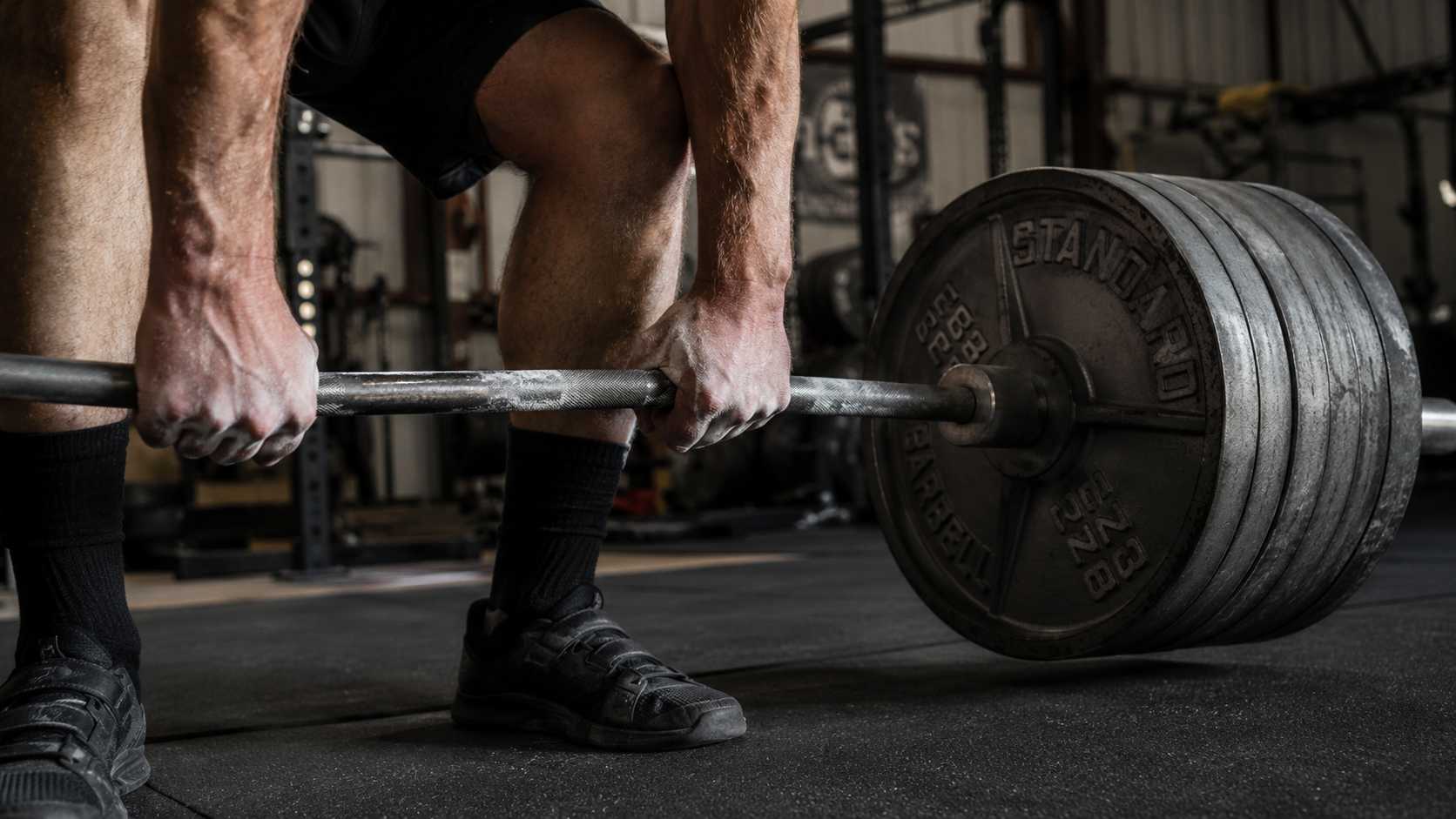
Walk up to a loaded bar on the floor. Hinge at your hips, grip the bar just outside your shins, brace your core, and stand up. That is a deadlift.
Key points for beginners:
- Bar starts over the middle of your foot
- Shins nearly touching the bar before you pull
- Flat back — no rounding
- Push the floor away with your legs rather than pulling with your back
- Lock out by standing tall, not by leaning back
The deadlift trains more muscle than any other single exercise. It builds your entire posterior chain — hamstrings, glutes, lower back, upper back, traps, and grip. It is also the lift where you will move the most weight, which is deeply satisfying.
4. The Overhead Press
Stand with the bar resting on your front shoulders. Press it straight overhead until your arms are locked out. Lower it back to your shoulders.
Key points for beginners:
- Grip just outside shoulder width
- Keep your core tight — do not arch your lower back
- Move your head out of the way as the bar passes your face
- Lock the bar out directly over the middle of your foot
- This lift will feel hard. It is supposed to. Your overhead press will always be your lightest lift.
The overhead press builds strong, functional shoulders and teaches your body to stabilize weight overhead. It is also the lift that most commercial gyms have abandoned in favor of machines, which is one reason most people have weak shoulders.
5. The Barbell Row
Hinge at the hips with a slight knee bend, grip the bar with an overhand grip, and pull it to your lower chest. Lower it back under control.
Key points for beginners:
- Keep your back flat and your torso roughly 45 degrees to the floor
- Pull with your elbows, not your hands
- Squeeze your shoulder blades at the top
- Do not use momentum — if you are swinging the weight, it is too heavy
The row balances out all the pressing you do and builds a thick, strong back. It also reinforces the hip hinge pattern you need for deadlifts.
How to Structure Your First Program
You do not need a complicated program. You need a simple one that you will actually follow. Here is what works for beginners:
Train three days per week. Monday, Wednesday, Friday or Tuesday, Thursday, Saturday. Your body needs rest days between sessions to recover and grow stronger.
Alternate between two workouts:
Workout A:
- Squat: 3 sets of 5 reps
- Bench Press: 3 sets of 5 reps
- Barbell Row: 3 sets of 5 reps
Workout B:
- Squat: 3 sets of 5 reps
- Overhead Press: 3 sets of 5 reps
- Deadlift: 1 set of 5 reps
Week one: A, B, A. Week two: B, A, B. Keep alternating.
Add weight every session. Start light — lighter than you think you need to. Add five pounds to each lift every time you complete all your sets and reps. For deadlifts, add ten pounds per session. This linear progression will take you further than any complicated periodization scheme.
This approach is based on proven programs like Starting Strength and StrongLifts that have been putting muscle and strength on beginners for decades.
Common Mistakes Beginners Make
Going too heavy too fast. Your first priority is learning the movements correctly. Ego lifting with bad form leads to injury and stalls progress. Start with the empty bar and add weight slowly.
Skipping sessions. Three days a week is not a lot. Missing one session means you only trained twice that week. Missing two means you barely trained at all. Consistency beats intensity every time.
Program hopping. A beginner does not need to change programs every four weeks. Stick with the basics for at least three to six months. The simple program stops working eventually, but not for a long time. You will know when it is time to change because progress will genuinely stall, not because you got bored.
Not eating enough. You cannot build muscle and strength without fuel. If you are training hard three days a week and not getting stronger, you are probably not eating enough protein. Aim for roughly one gram of protein per pound of body weight per day. Chicken, beef, eggs, dairy, and protein shakes all count.
Overthinking accessories. Bicep curls and tricep extensions are fine, but they are not the priority. The five barbell movements should make up the core of your training. If you have energy left after your main lifts, add accessories. If you do not, skip them. The big lifts are what drive progress.
What to Expect in Your First Month
The first two weeks will feel awkward. The bar will feel unstable. You will not know where to put your hands. Your form will be rough. This is normal. Every single person who lifts went through this phase.
By week three, the movements will start to feel more natural. The weight will start to feel lighter — not because you are suddenly strong, but because your nervous system is learning the patterns. You are developing coordination before you develop strength.
By the end of your first month, you will be adding weight to the bar every session and feeling a difference in how your body moves and feels. Your clothes will fit differently. You will sleep better. You will stand taller. These are not exaggerations. Barbell training changes your body faster than almost any other form of exercise.
Why Raise the Bar Performance Is the Right Place to Start
Starting barbell training at a commercial gym can be frustrating. Most have one or two squat racks shared by dozens of members. The equipment is designed for casual fitness, not serious strength work. And the atmosphere often discourages the kind of focused, heavy training that produces results.
Raise the Bar Performance in Huntingburg, Indiana was built specifically for barbell training. Our facility at 516 E 6th St has multiple power racks, dedicated deadlift platforms, competition benches, and a full range of plates from 2.5 pounds up. You will not wait in line for a rack. You will not feel out of place. And because we are open 24 hours a day, you can train when it works for you — not when it works for the gym.
Whether you are a complete beginner who has never touched a barbell or someone coming back to training after time away, this is a place where strength is built from the ground up. No judgment. No gimmicks. Just barbells, plates, and the work.
Take the First Step
The hardest part of starting is starting. You do not need to be in shape to walk into a gym. That is what the gym is for.
If you are in Huntingburg, Jasper, Ferdinand, or anywhere in Dubois County and you have been thinking about getting stronger, stop thinking and start doing. Come in during staffed hours to tour the facility, or sign up online and start training today. The equipment is here. The space is here. The only thing missing is you.